
Last Updated: November 26, 2026
Quick Summary
You avoid fake looking scalp micropigmentation by treating it as a design problem, not a purchase. Natural results come from a soft, irregular hairline, pigment matched to your skin undertone, follicle dots that vary in size and spacing, and an artist who shows healed work.
- A natural hairline is a zone of scattered dots that fade unevenly, never a solid line.
- Follow your mature hairline, not your teenage one, and let temple corners recede slightly.
- Ask for healed photos taken in daylight and at least three months old.
- Ignore fresh-session shine, because fresh SMP always looks sharper than healed SMP.
- A hard or low hairline is corrected by adding lighter dots above it, not removing ink.
Table of Contents
- How can you avoid fake looking scalp micropigmentation?
- Scalp micropigmentation hairline design: creating a soft, irregular hairline
- How to choose an SMP artist: a vetting checklist
- Botched scalp micropigmentation: what to do if it already looks fake
- Frequently Asked Questions
How can you avoid fake looking scalp micropigmentation?
You avoid fake looking scalp micropigmentation by treating it as a design problem, not a purchase. It looks natural when the hairline is soft and irregular, the pigment matches your skin undertone, the follicle dots vary in size and spacing, and the artist shows healed work.
What makes SMP look fake is visible from across a room:
- A straight, low, or perfectly solid hairline
- One dot size repeated across the whole scalp
- Pigment darker than the surrounding hair
- Dots placed in rows instead of a natural follicle pattern
- No blending into your remaining hair
Below, we break down each, then give you a vetting checklist and a plan if the work is already done.
Scalp micropigmentation hairline design: creating a soft, irregular hairline
The hairline is where fake SMP gets caught. A natural hairline is never a line but a zone of scattered follicle impressions that fade unevenly at the edge.
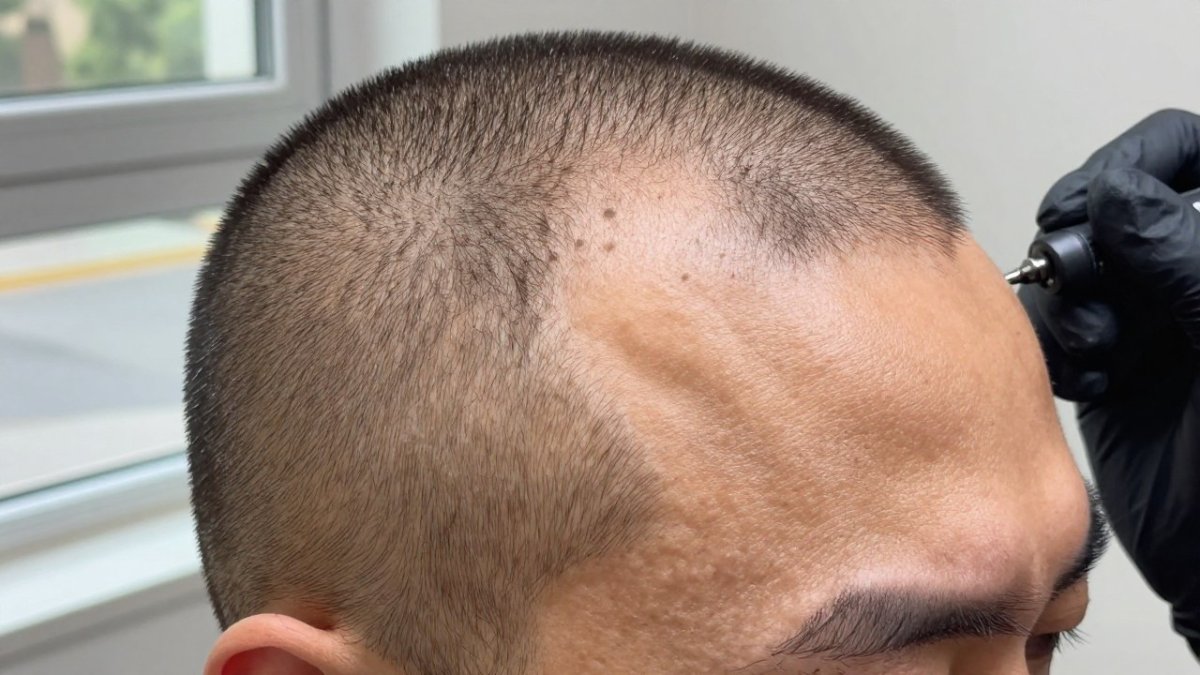
Three design rules do most of the work:
- Follow your mature hairline, not your teenage one. A low, straight hairline on a 45-year-old reads as a hairpiece immediately.
- Break the edge. The front border should be single, spaced dots that thin out, never a filled band.
- Match the recession you would have had. Temple corners should recede slightly. A perfectly square front is the most common fake-looking result we correct.
For a deeper walkthrough of building a believable edge, read our guide on how to get a natural looking hairline for SMP.
How to choose an SMP artist: a vetting checklist
Choosing an artist comes down to evidence: healed photos, honest talk about limits, and a clear plan before you commit.
Use this checklist in the consultation:
- Healed photos, taken in daylight, at least three months old
- Before-and-after images from the same angle and lighting
- Close-ups of the hairline, not just full-head shots
- Examples on skin tone close to yours
- A clear explanation of pigment choice and needle depth
- Honest talk about fading and touch-ups
- [ ]
- A written plan for how the result ages with your hair loss
How to read a portfolio: ignore styling, lighting, and fresh-session shine. Fresh SMP always looks sharper than healed SMP. Ask for healed results, because that is what you will live with.
Two practical steps before you commit: prepare for your SMP consultation so you ask the right questions, and know how to book a scalp micropigmentation consultation so you compare artists on the same basis.
| Natural-looking SMP | Fake-looking SMP |
|---|---|
| Soft, broken hairline edge | Solid, straight hairline |
| Mixed dot sizes and spacing | Uniform dots in rows |
| Pigment matched to hair and skin | Pigment darker than hair |
| Blends into remaining hair | Hard stop at the hairline |
| Slight recession at temples | Square, low front line |
Botched scalp micropigmentation: what to do if it already looks fake
Fake-looking SMP may be improvable, but the right approach depends on what went wrong and should be confirmed in an assessment.
Start by identifying the problem honestly:
- Blue or gray tint: pigment placed too deep or mixed wrong. This needs assessment before anything else. Our breakdown of why SMP pigment turns blue or green explains the causes and correction options.
- Too dark overall: often settles with time, but a hard edge will not fix itself.
- Hard or low hairline: correction means adding lighter dots above the line and softening the edge, not removing ink.
- Patchy density: usually a session-count problem, correctable with additional work.
Before committing to any correction, ask what the plan involves and how many sessions it requires.
When you are ready, you can request an SMP quote to discuss your options.
If your SMP already looks fake, a consultation is a sensible first step. At Digital Barbershop, Master Barber and SMP Artist Sylvester W. Jr. provides a tailored assessment and clear expectations before treatment begins.
Frequently Asked Questions
Does scalp micropigmentation look fake?
Scalp micropigmentation can look fake when the hairline is too straight, the pigment is too dark or cool-toned, or the follicle dots are uniform in size and spacing. Natural-looking results depend on a soft, irregular hairline, a pigment shade matched to your skin undertone, and varied dot placement. Choosing an artist who shows healed results and provides a tailored assessment can help you set realistic expectations.
How can I choose an SMP artist who creates natural-looking results?
Ask to see healed before and after photos, not just fresh sessions. Check that hairlines look soft and irregular, and that dot size and spacing vary naturally. Confirm the artist matches pigment to your skin tone and discusses needle depth. A practical vetting checklist includes reviewing a portfolio of healed results and asking how fading and touch-ups are handled.
Can a bad SMP hairline be corrected?
Yes, many botched scalp micropigmentation results can be improved. Many concerns with existing SMP are best addressed after a consultation, where an artist can assess the work and discuss possible next steps.

Leave a Reply